The Rise of the Living AI Business Office
What we mean by an AI office, what the evidence says about how ready the technology is, and why the humans stay in charge.
By Autonomyx Solutions · · 3 min read
A note on what this is: a perspective on a product category we build. It’s not a research report, and we have no client results to share. The facts below come from outside sources. The framing is ours.
The idea
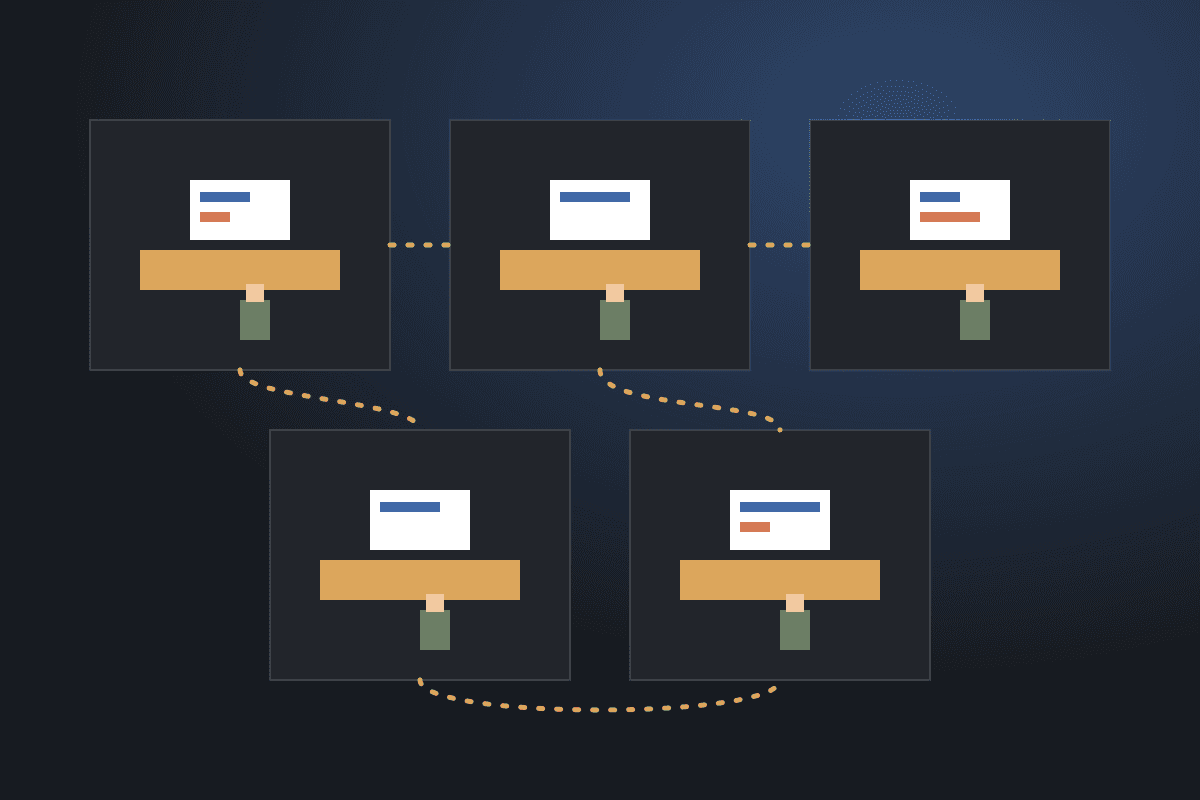
Most businesses run on handoffs: a lead comes in, someone qualifies it, someone schedules it, someone invoices it, someone follows up. A living AI business office is a way of putting those handoffs in one place and letting software carry routine work between desks, with people approving what matters. Think of a small team where some of the teammates are software.
Concretely, an AI office tends to cover intake, sales, scheduling, finance and support. Each “desk” has a defined job, defined inputs and a defined output, and a place where a person says yes or no. The “living” part is that you can see it working: what came in, who has it, what’s waiting on you.
What the evidence says about readiness
Read together: the technology is capable and improving fast, but it’s not reliable enough for unattended control of anything that matters, and most organizations haven’t integrated it deeply. That points to a design: automate the handoffs, put AI where fuzzy judgment helps, and keep a person at the gates.
How we’d build one
- Start with one desk. Pick the workflow that costs the most time, usually intake or scheduling, and make it work end to end.
- Fixed paths first, AI inside them. Use ordinary automation for the predictable parts and a model only for the fuzzy step.
- Approval gates. Customer messages, prices, and anything involving money wait for a person.
- An audit trail. You can see what happened, why, and how to undo it.
- Add desks later. Sales, support, finance and the rest come in phases, not all at once.
What to settle before building one
- Inputs: where does work arrive today, and can those channels feed one intake?
- Owners: who approves what? Every desk needs a named human.
- Failure plan: what happens when a step is wrong or the system is down? There should always be a manual path.
- Phase one scope: one workflow, one desk, one measurable result.
- Out of bounds: we’d keep unsupervised money movement, legal or medical judgment, and unreviewed outbound messaging to customers off the list for now.
A good first month looks unglamorous: one inbox, one board, one reply drafted for approval. That’s a feature. Unglamorous systems are the ones that survive contact with a Monday morning.
Takeaways
- An AI office is a set of connected workflows with defined desks, handoffs and approval gates.
- Current evidence supports AI assistance with human review, not unattended control.
- Start with one workflow, build outward in phases, and insist on an audit trail.
- Judge any AI-office pitch by visibility, control and a measurable time saving.
Sources
Checked against the linked pages on October 30, 2026. Statistics are quoted as published, with their survey years.
- Stanford HAI: 2026 AI Index Report, key takeaways (OSWorld results)
- Federal Reserve Banks: 2026 Report on Employer Firms (Small Business Credit Survey)
- Gartner press release: agentic AI predictions (June 25, 2025). Predictions, not measurements.
- Anthropic Engineering: Building effective agents (Dec 19, 2024)
Related service
See the AI Office demo on our Work page, then tell us which desk you’d start with.